Learning to Die in the Anthropocene — Roy Scranton
Roy Scranton
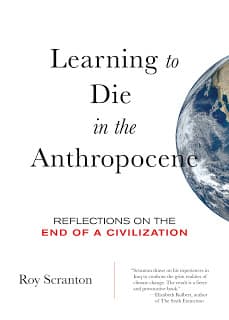
Learning to Die in the Anthropocene: Reflections on the End of a Civilization City Lights Books, 2015. ISBN 978-0872866690
"In Learning to Die in the Anthropocene, Roy Scranton draws on his experiences in Iraq to confront the grim realities of climate change. The result is a fierce and provocative book." — Elizabeth Kolbert, Pulitzer Prize-winning author of The Sixth Extinction
"Roy Scranton's Learning to Die in the Anthropocene presents, without extraneous bullshit, what we must do to survive on Earth. It's a powerful, useful, and ultimately hopeful book that more than any other I've read has the ability to change people's minds and create change." — Jeff VanderMeer, author of the Southern Reach trilogy
"An eloquent, ambitious, and provocative book." — Rob Nixon, author of Slow Violence and the Environmentalism of the Poor
"Roy Scranton has written a howl for the Anthropocene — a book full of passion, fire, science and wisdom. It cuts deeper than anything that has yet been written on the subject." — Dale Jamieson, author of Reason in a Dark Time
What it is
Scranton combines memoir, reportage, philosophy, and Zen wisdom to explore what it means to be human in a rapidly evolving world. Drawing on his experience as a US Army veteran in Iraq — where he saw "the same chaos and collapse" in Baghdad that he later saw after Hurricane Katrina — he argues that climate change is not a political or technical problem but an existential one. To survive, we must learn to die: not as individuals, but as a civilization.
The book traces its origin to Scranton's New York Times essay (the #1 most-emailed article the day it appeared, selected for Best American Science and Nature Writing 2014). Expanding on that, he journeys through street protests, the latest earth science, a historic UN summit, millennia of geological history, and the persistent vitality of ancient literature.
Plato argued that to philosophize is to learn to die. If that's true, says Scranton, then we have entered humanity's most philosophical age — because this is precisely the problem of the Anthropocene.
The core argument
The book's diagnosis of why the climate response has failed is striking:
"In a perverse irony, one of the main things that connected the disparate parties at the United Nations, Flood Wall Street, the IETA, and the People's Climate March was a system of cultural technology that is silently burning up masses of carbon while shunting activist outrage into impotent feedback loops."
"The global information and communications ecosystem that they were plugged into is now estimated to use about 10 percent of the world's electricity. That ecosystem relies on coal. Every time you check your email, you're heating up the planet. We do it every day. We can't stop. We won't stop."
And the closing diagnosis on page 68:
The problem with the People's Climate March wasn't really that it lacked a goal, or that it was distracting, superficial, and vacuous. The problem with the United Nations isn't that the politicians there are ignorant, hidebound, self-interested, or corrupt. The problem with our response to climate change isn't a problem with passing the right laws or finding the right price for carbon or changing people's minds or raising awareness. Everybody already knows. The problem is that the problem is too big. The problem is that different people want different things. The problem is that nobody has real answers. The problem is that the problem is us.
A paradox worth sitting with (p. 116)
For a growth of carbon scum on a spinning rock in the backwater of an unremarkable galaxy light years from anywhere to develop the technology to send radio telescopes into space to measure the age of the universe is a prodigious achievement. Our primate curiosity and intellectual hubris have inspired breathtaking audacities. Just a few thousand years ago, we were learning to make marks on clay. In the blink of an eye, we've brushed our fingers against eternity.
And a few paragraphs later:
It may be that we have crossed the summit of our knowledge and power, and the brief explosion of human life in the Holocene will turn out to have been as transient as an algae bloom. It may be, on the other hand, that we'll find a way to survive in the Anthropocene, perhaps even find ways to maintain human civilization in some recognizable form. Whether we survive or not, however, has already been laid out in the explosion of quantum energy that, more than thirteen billion years ago, began the chain of events and reactions that have led to this moment: me writing this page, you reading it.
The paradox the user flagged: the same knowledge and intelligence that lets us measure the age of the universe is what got us into the climate crisis — and knowledge alone won't get us out. Knowledge and smarts are not wisdom. The book's title captures this: learning to die is not about knowledge, it's about acceptance, orientation, and a different kind of intelligence. The "problem is that the problem is us" — collective action problems, conflicting desires, nobody having real answers — is fundamentally a failure of wisdom and coordination, not of information.
Violence and the compulsion of strife (pp. 74–75)
activists struggling for civil rights didn't just tweet hashtag campaigns. They didn't just hold meetings. They fought and bled and died for a world they believed in, for a share in the power they produced. Coal strikes throughout the 1910s and early 20th century were scenes of violence and turmoil, and it was only through labor's aggressive war on the owners of capital that they were able to win rights that for some decades we considered basic, such as the right to organize or the right to an eight-hour workday. Similarly, the fight to win fundamental civil rights and political equality from segregationists and racists was grinding, dangerous, and aggressive: it strove to take something from Southern white racists that they didn't want to give up, namely power.
Some like to say that "violence never solved anything," but this is a comforting lie, and it's comforting to precisely the wrong people. The real reason that non-violence is considered to be a virtue in the powerless is that the powerful do not want to see their lives or property threatened. As a matter of fact, violence has solved many conflicts. Violence defeated fascism and Nazism in World War II. Violence enforced the end of slavery during the Reconstruction following the American Civil War. Violence freed the American colonies from British rule, just as it freed numerous other colonies across the world from imperial domination. Violence deposed the malignant French aristocracy in 1789 and overthrew the despotic Russian aristocracy in 1917. Violence was central to the successes of the labor movement, and the threat of violence was key to the struggle for Civil Rights. Violence has also been used to conquer vulnerable
nations, oppress the weak, torture innocents, threaten critics, force women to submit to rape, pillage cities, and eradicate entire populations. A sword is a sword, whichever way it cuts.
For most of human history, violence has been a central element of social conflict. The first clear evidence of mass human violence is as old as civilization; the first evidence of humanity has yet to be seen.⁸⁴ According to bioarchaeologist Philip Walker, "As far as we know, there are no forms of social organization, modes of production, or environmental settings that remain free from interpersonal violence for long."⁸⁵ As Freud wrote in his famous debate with Einstein on the question of war, "It is a general principle … that conflicts of interest between men are settled by the use of violence. This is true of the whole animal kingdom, from which men have no business to exclude themselves."⁸⁶ The long record of human brutality seems to offer conclusive evidence that both individual and socially organized violence are as biologically a part of human life as are sex, language, and eating, that aggression and the drive for dominance are neither vestigial atavisms nor social maladaptations but rather species traits, and that we have little reason to hope that war and murder might someday disappear.
Our future promises to be as savage as our past. While it may be true that two centuries of carbon-fueled economy have led to a general decrease in daily violence, at least in industrialized nations, the human animal has not purged itself of bloodlust, nor have we put war and violence aside.
Related
- techno-solutionism-and-mitigation — why technologists have already given up on (sufficient) mitigation
- meta-vs-specific-solutions-debates — the gap between meta solutions (carbon pricing) and specific-solution lists (Project Drawdown)
- ipcc-special-report-1.5-degrees-2018 — the key reference document on what 1.5°C actually implies
- Roy Scranton's website — ordering, full description
- New York Times essay — the essay the book expands from
References to look up
From the book's bibliography — three works worth tracking down:
-
Mike Hulme, Why We Disagree About Climate Change: Understanding Controversy, Inaction and Opportunity. Cambridge University Press, 2009. ISBN 978-0521727327.
-
Kari Marie Norgaard, Living in Denial: Climate Change Emotions in Everyday Life. MIT Press, 2011.
-
Vaclav Smil, Global Catastrophes and Trends: The Next 50 Years. MIT Press, 2008.
