Special Report: Global Warming of 1.5 ºc - Summary for Policy-makers (6 October 2018)
Special Report: Global Warming of 1.5 ºc - Summary for Policy-makers (6 October 2018)
Keeping to 1.5ºC implies a remaining carbon budget of 420 GtCO2 (as of 2018) and using at rate of 42Gt a year which implies max 10y at current rates
C.1.3. Limiting global warming requires limiting the total cumulative global anthropogenic emissions of CO2 since the pre-industrial period, that is, staying within a total carbon budget (high confidence).By the end of 2017, anthropogenic CO2 emissions since the pre-industrial period are estimated to have reduced the total carbon budget for 1.5°C by approximately 2200 ± 320 GtCO2 (medium confidence). The associated remaining budget is being depleted by current emissions of 42 ± 3 GtCO2 per year (high confidence). The choice of the measure of global temperature affects the estimated remaining carbon budget. Using global mean surface air temperature, as in AR5, gives an estimate of the remaining carbon budget of 580 GtCO2 for a 50% probability of limiting warming to 1.5°C, and 420 GtCO2 for a 66% probability (medium confidence).Alternatively, using GMST gives estimates of 770 and 570 GtCO2, for 50% and 66% probabilities,respectively (medium confidence). Uncertainties in the size of these estimated remaining carbon budgets are substantial and depend on several factors. Uncertainties in the climate response to CO2 and non-CO2 emissions contribute ±400 GtCO2 and the level of historic warming contributes ±250 GtCO2 (medium confidence). Potential additional carbon release from future permafrost thawing and methane release from wetlands would reduce budgets by up to 100 GtCO2 over the course of this century and more thereafter (medium confidence). In addition, the level of non-CO2 mitigation in the future could alter the remaining carbon budget by 250 GtCO2 in either direction (medium confidence). {1.2.4, 2.2.2, 2.6.1, Table 2.2, Chapter 2 Supplementary Material}
Certainty in output. Some uncertainty in output ≥ warming.
They don't take SRM (solar radiation modification) seriously
C.1.4. Solar radiation modification (SRM) measures are not included in any of the available assessed pathways. Although some SRM measures may be theoretically effective in reducing an overshoot, they face large uncertainties and knowledge gaps as well as substantial risks and institutional and social constraints to deployment related to governance, ethics, and impacts on sustainable development. They also do not mitigate ocean acidification. (medium confidence). {4.3.8, Cross-Chapter Box 10 in Chapter 4}
However all their scenarios (Figure SPM.3B) assume carbon dioxide removal and capture
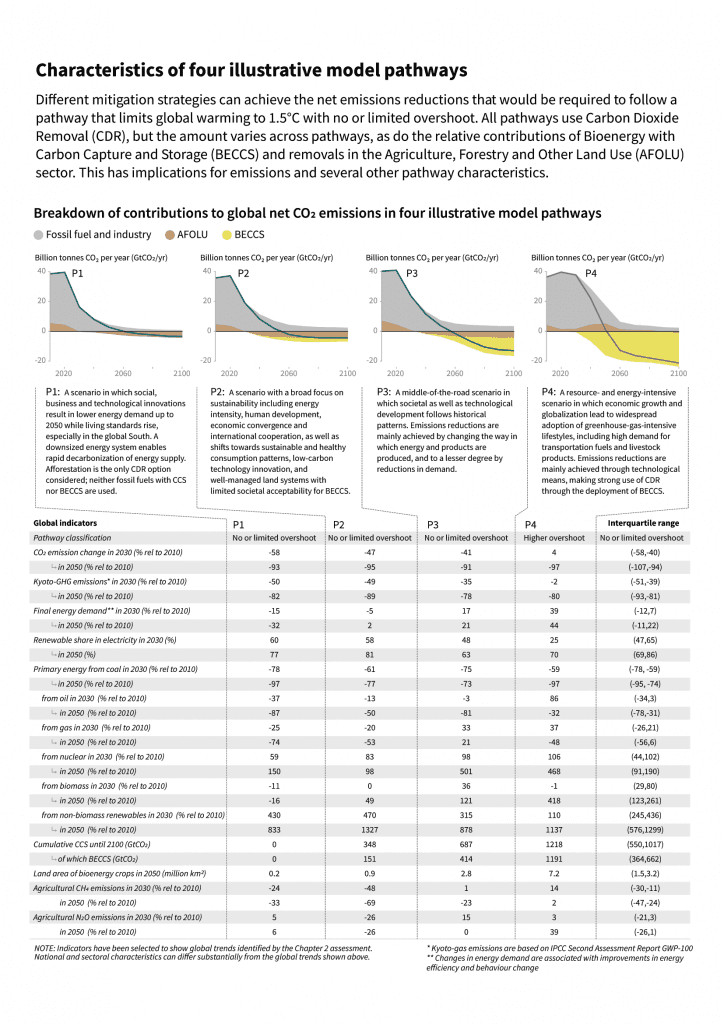
Would need massive changes that are unprecedented in scale if not in speed
C.2. Pathways limiting global warming to 1.5°C with no or limited overshoot would require rapid and far-reaching transitions in energy, land, urban and infrastructure (including transport and buildings), and industrial systems (high confidence). These systems transitions are unprecedented in terms of scale, but not necessarily in terms of speed, and imply deep emissions reductions in all sectors, a wide portfolio of mitigation options and a significant upscaling of investments in those options (medium confidence). {2.3, 2.4, 2.5, 4.2, 4.3, 4.4, 4.5}
Would have to involve lower energy use
C.2.2. In energy systems, modelled global pathways (considered in the literature) limiting global warming to 1.5°C with no or limited overshoot (for more details see Figure SPM.3b) generally meet energy service demand with lower energy use, including through enhanced energy efficiency, and show faster electrification of energy end use compared to 2°C (high confidence).
This would involve massive transport and building changes e.g. going from 5% of low emission transport in 2020 to about 35–65% in 2050
C.2.4. The urban and infrastructure system transition consistent with limiting global warming to 1.5°C with no or limited overshoot would imply, for example, changes in land and urban planning practices, as well as deeper emissions reductions in transport and buildings compared to pathways that limit global warming below 2°C (medium confidence). Technical measures and practices enabling deep emissions reductions include various energy efficiency options. In pathways limiting global warming to 1.5°C with no or limited overshoot, the electricity share of energy demand in buildings would be about 55–75% in 2050 compared to 50–70% in 2050 for 2°C global warming (medium confidence). In the transport sector, the share of low-emission final energy would rise from less than 5% in 2020 to about 35–65% in 2050 compared to 25–45% for 2°C of global warming (medium confidence). Economic, institutional and socio-cultural barriers may inhibit these urban and infrastructure system transitions, depending on national, regional and local circumstances, capabilities and the availability of capital (high confidence). {2.3.4, 2.4.3, 4.2.1, Table 4.1, 4.3.3, 4.5.2}
All pathways assume carbon dioxide removal (CDR)
C.3. All pathways that limit global warming to 1.5°C with limited or no overshoot project the use of carbon dioxide removal (CDR) on the order of 100–1000 GtCO2 over the 21st century. CDR would be used to compensate for residual emissions and, in most cases, achieve net negative emissions to return global warming to 1.5°C following a peak (high confidence). CDR deployment of several hundreds of GtCO2 is subject to multiple feasibility and sustainability constraints (high confidence). Significant near-term emissions reductions and measures to lower energy and land demand can limit CDR deployment to a few hundred GtCO2 without reliance on bioenergy with carbon capture and storage (BECCS) (high confidence). {2.3, 2.4, 3.6.2, 4.3, 5.4}
However there are major feasibility questions on CDR
From that previous paragraph:
CDR deployment of several hundreds of GtCO2 is subject to multiple feasibility and sustainability constraints (high confidence).
And later on …
C.3.4. Most current and potential CDR measures could have significant impacts on land, energy, water or nutrients if deployed at large scale (high confidence). Afforestation and bioenergy may compete with other land uses and may have significant impacts on agricultural and food systems, biodiversity, and other ecosystem functions and services (high confidence).
Paris Ambitions are not ambititious enough
D.1. Estimates of the global emissions outcome of current nationally stated mitigation ambitions as submitted under the Paris Agreement would lead to global greenhouse gas emissions in 2030 of 52–58 GtCO2eq yr−1 (medium confidence). Pathways reflecting these ambitions would not limit global warming to 1.5°C, even if supplemented by very challenging increases in the scale and ambition of emissions reductions after 2030 (high confidence). Avoiding overshoot and reliance on future large-scale deployment of carbon dioxide removal (CDR) can only be achieved if global CO2 emissions start to decline well before 2030 (high confidence). {1.2, 2.3, 3.3, 3.4, 4.2, 4.4, Cross-Chapter Box 11 in Chapter 4}
Pathways that limit warming to 1.5°C show a significant reduction of emissions by 2030 vs 2010 (40-50% range of reduction) and current trajectories will result in 3º warming)
D.1.1. Pathways that limit global warming to 1.5°C with no or limited overshoot show clear emission reductions by 2030 (high confidence). All but one show a decline in global greenhouse gas emissions to below 35 GtCO2eq yr−1 in 2030, and half of available pathways fall within the 25–30 GtCO2eq yr−1 range (interquartile range), a 40–50% reduction from 2010 levels (high confidence). Pathways reflecting current nationally stated mitigation ambition until 2030 are broadly consistent with cost-effective pathways that result in a global warming of about 3°C by 2100, with warming continuing afterwards (medium confidence). {2.3.3, 2.3.5, Cross-Chapter Box 11 in Chapter 4, 5.5.3.2}
Wow, we are really in trouble. AFAICT emissions rates have climbed since 2014 and we are nowhere near on target for a reduction of 45-50% vs 2010.
Once we have overshot it is hard to come back so if we overshoot (as projected) it will be very costly or impossible to correct
D.1.2. Overshoot trajectories result in higher impacts and associated challenges compared to pathways that limit global warming to 1.5°C with no or limited overshoot (high confidence). Reversing warming after an overshoot of 0.2°C or larger during this century would require upscaling and deployment of CDR at rates and volumes that might not be achievable given considerable implementation challenges (medium confidence). {1.3.3, 2.3.4, 2.3.5, 2.5.1, 3.3, 4.3.7, Cross-Chapter Box 8 in Chapter 3, Cross-Chapter Box 11 in Chapter 4}
There are potentially tensions with some SDGs (those which are growth oriented)
D.4.1. 1.5°C pathways have robust synergies particularly for the SDGs 3 (health), 7 (clean energy), 11 (cities and communities), 12 (responsible consumption and production) and 14 (oceans) (very high confidence). Some 1.5°C pathways show potential trade-offs with mitigation for SDGs 1 (poverty), 2 (hunger), 6 (water) and 7 (energy access), if not managed carefully (high confidence). (Figure SPM.4) {5.4.2; Figure 5.4, Cross-Chapter Boxes 7 and 8 in Chapter 3}
