Economic Impact of Climate Change
Economic Impact of Climate Change
Notes
From [@auffhammer-2018-quantifying-economic-damages] - 2022-07-02
Standard Economic Models of Damage (Integrated Assessment Models) were quite poor and strongly criticized by non-economists
The estimates also do not incorporate any of the major updates suggested by the National Academies of Sciences (2017) report, which implies that the 2018 estimates do not represent best available science. For example, the National Academies of Sciences made suggestions relating to how one constructs a baseline future economy out to the year 2300, assumptions made in the climate modeling, and the discounting approach taken. Maybe most importantly for the purposes of this paper, the National Academies of Sciences report points a stern finger at the damage functions used in all three Integrated Assessment Models.
The damage functions in the Integrated Assessment Models, which are used to calculate the social cost of carbon, are outdated. Greenstone (2016) points out that the most recent studies in the FUND model stem from 2009, with the majority of the literature cited stemming from the early and mid-1990s. For example, the damage function for agriculture in the FUND model implies that warming up to roughly 5°C produces benefits for the sector (Rose et al. 2014). This is not consistent with the recent literature on agricultural impacts, which for example, points at the significant negative impact of extreme heat days. Moore, Baldos, Hertel, and Diaz (2017) updated the FUND damage function by incorporating the most recent empirical estimates for agriculture and find a doubling of the social cost of carbon by simply updating this sector alone. The literature underlying the DICE damage function also mostly comes from studies conducted in the 1990s. None of the cites for the PAGE model are from after 2010. As Greenstone (2016) shows, this ignores more than 100 studies published since 2010—which use more up-to-date econometric techniques and exploit the explosion in data availability.
All one can say is "wow, just wow". How, could these models be so unrealistic and so poorly done?
Damage Functions, Weather and Climate
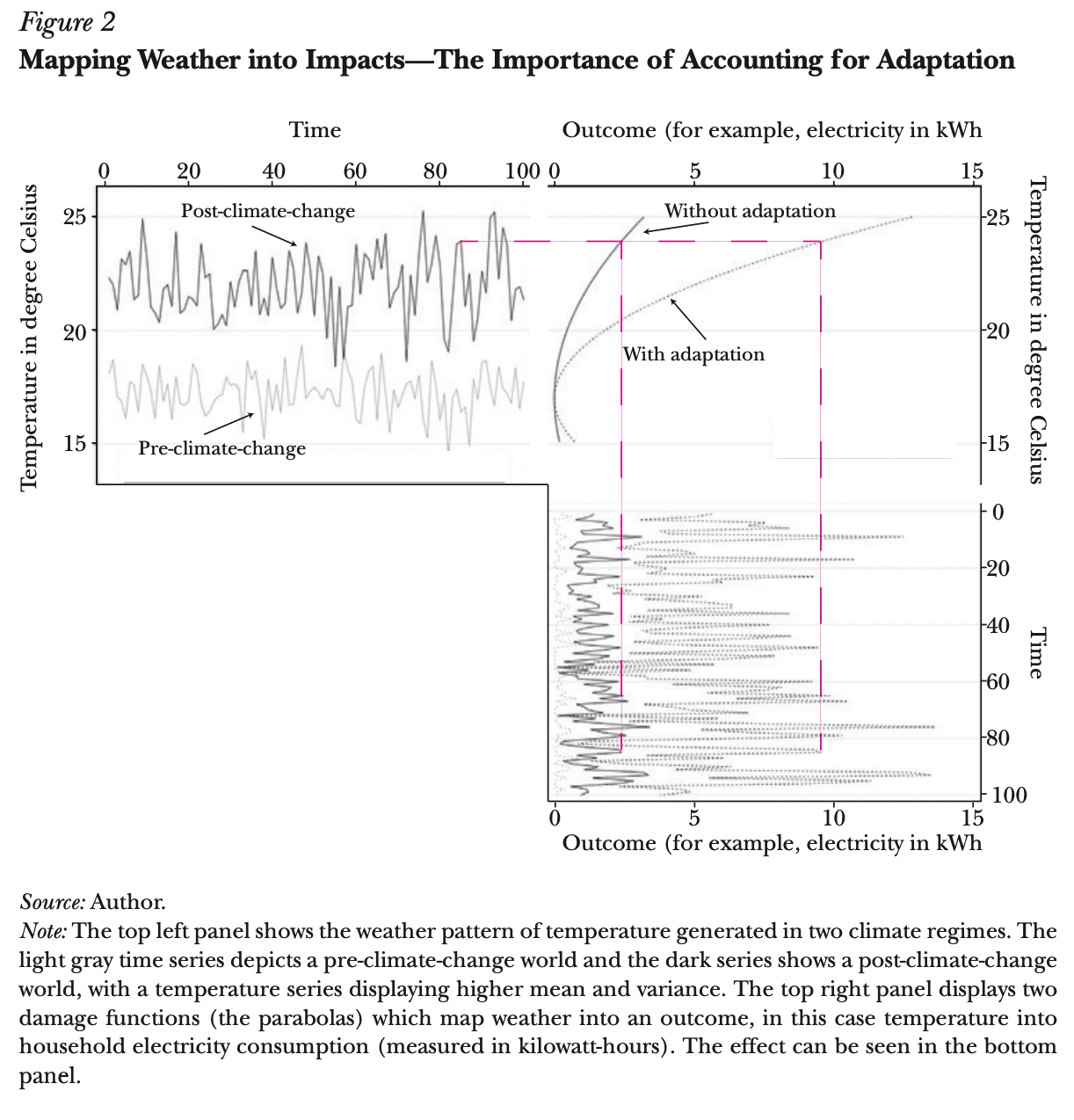
Challenge of mapping Weather ≥ Climate ≥ Damage Functions
Plus including intensive (using air conditioners more) and extensive response (i.e. installing air conditioners)
Papers using better approaches find impacts an order of magnitude larger e.g. around 20% of GDP
The papers leaning on this approach most strongly are panel studies of GDP growth rates across countries as a function of annual temperature fluctuations (Dell, Jones, and Olken 2012; Burke, Hsiang, and Miguel 2015a). The most recent of these papers find impacts of climate change on global GDP around 20 percent by end of the century, which is an order of magnitude larger than what is found by most Integrated Assessment Models. There is broad enthusiasm for this approach, especially in the interdisciplinary climate literature.
What We Know and What We Don’t
Cline (1992) put forth a list of important sectors for which we require a better understanding of their climate sensitivity. Table 1 below replicates his table and I have subjectively filled in where this literature currently stands in terms of published and ongoing efforts. A glance shows that there is a lot of work to do.
Yet it is clear that the literature on the econometric estimation of damage functions of climate change is rapidly expanding—both in terms of methods as well as sectoral and spatial coverage. The previously stagnant state of affairs where most of the damage functions in Integrated Assessment Models had not been updated significantly in over a decade has changed dramatically. Economists need to push forward in improving sectoral and spatial coverage of the damage functions provided to modelers, using methods that allow us to parameterize plausibly causal damage functions, which account for adaptation and allow us to estimate welfare impacts of climate change. The current frontier is probably best described by work using the “Ricardo meets panel data” approach.
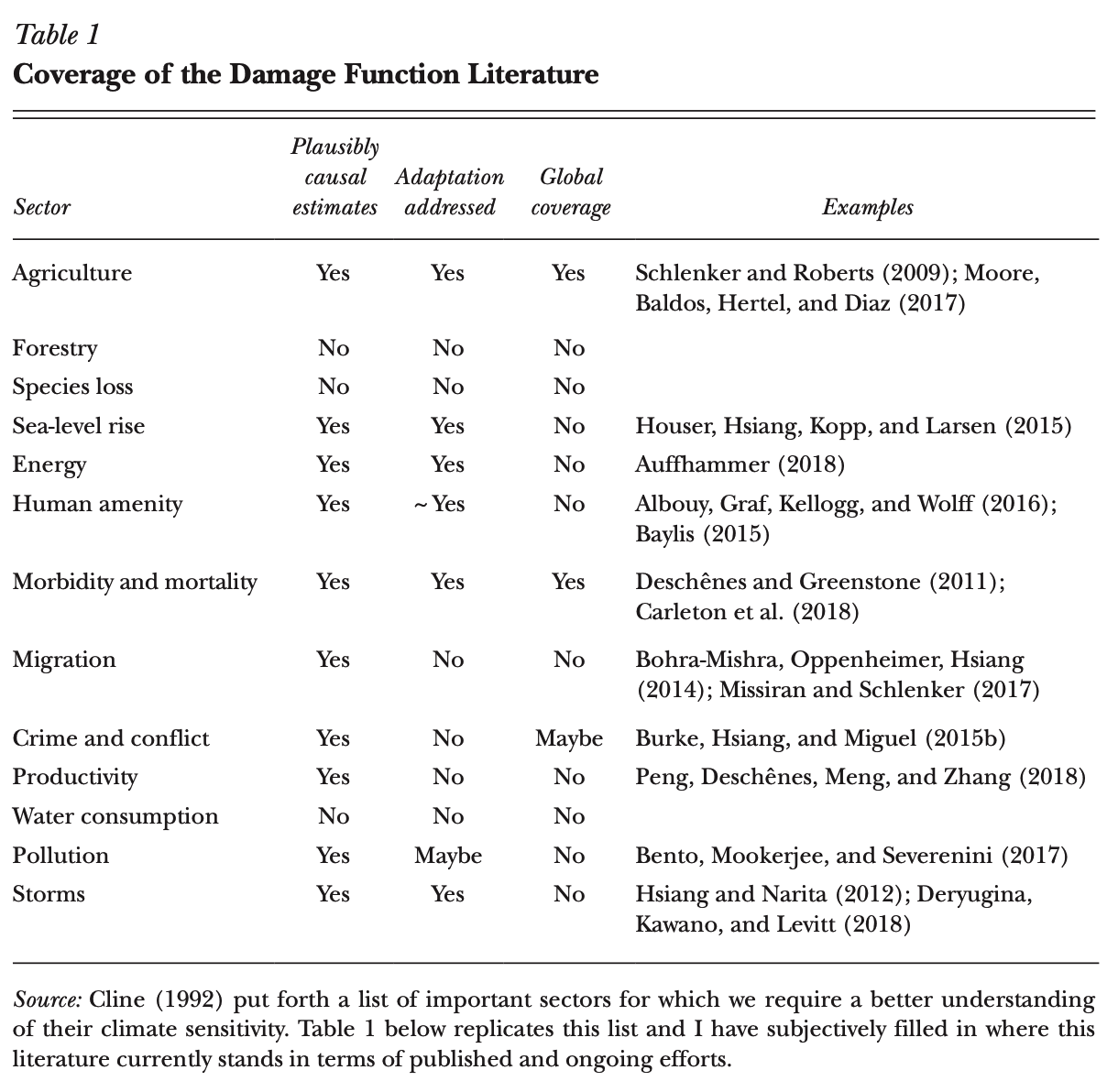
Just adding updated agricultural damage doubled social cost of carbon
Moore et al. (2017) is one published attempt to incorporate the most recent estimates of damage functions for the agricultural sector into an Integrated Assessment Model (the FUND model) and this one-sector exercise doubles the social cost of carbon (SCC), which underlines the importance of these efforts.
